
Science 4th grade | UNIT 3: Solids‚ liquids and gases 3.3 How do Solids‚ liquids and gases behave?
Solids
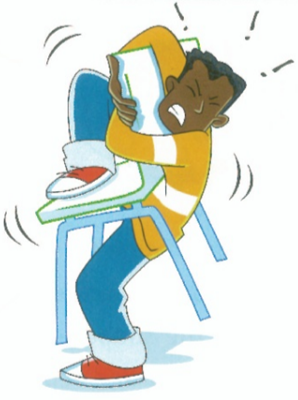
Try to squeeze your desk, chair or pencil. Can you make it a different shape?
Most solids can't be squashed into a different shape. Remember the particle model. Particles within a solid are packed closely together. There is no space for the particles to take on a different shape.
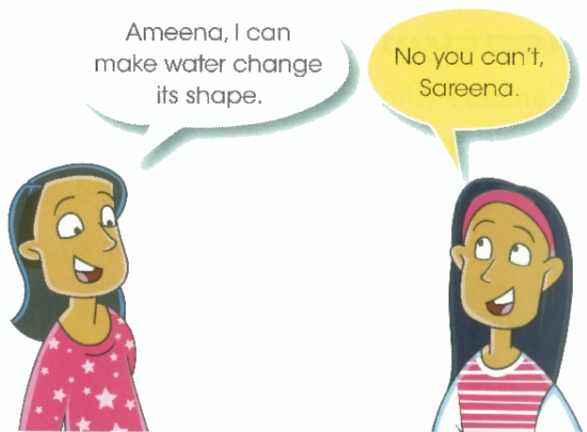
Ameena, I can make water change its shape.
Liquids
Predict what will happen when you pour some water onto a flat surface.
Activity 3.3a (Prove that water can change its shape)
Plan a demonstration to prove that water can change its shape when you pour it.
Decide on the equipment you will use and what you will do.
Now carry out the demonstration.
Use the particle model to explain why liquids can change their shape.
Gases
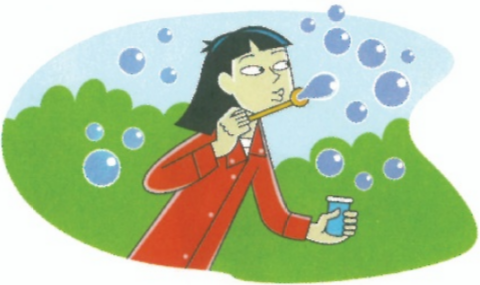
If gases are contained in something they take on the shape of the container. Look at the picture. Here the gas is contained inside the bubble. When there is no container gases spread out.
Activity 3.3b (Observing how gases behave)
You will need: soapy water - rings for blowing bubbles
Dip the ring into the soapy water. Blow air through the ring to make bubbles.
What is the gas inside the bubbles?
What happens to the gas when the bubble bursts?
Questions
1) a: Draw a picture of particles of air inside a bubble.
b: Draw the same number of particles of air when the bubble bursts.
2) Why can't you change the shape of a brick by squeezing it?
3) Draw a labelled diagram to explain how a puddle forms when it rains.
Challenge
Gas is sometimes used as a fuel for cooking Why do we keep this gas in sealed metal containers?